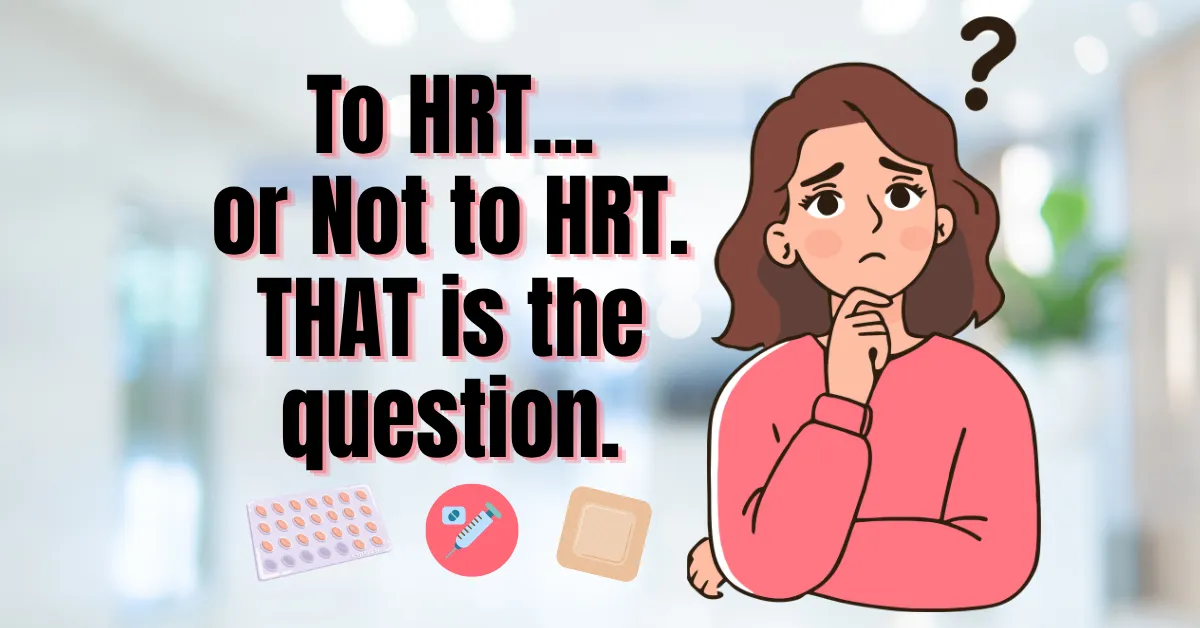
HRT Is Everywhere Right Now. But Is It the Whole Menopause Conversation?
Every menopause conversation I have lately ends up in the same place: hormone therapy. Even social media has a trend of women showing off their hormone patches.
Hormone replacement therapy, also called menopausal hormone therapy, is a genuinely effective treatment and I'm glad women are finally talking about it out loud. I spent six years of perimenopause not talking about it, collecting specialists instead. A neurologist. A urologist. A physical therapist. Three intelligent people, each looking at one symptom, none of them looking at the whole picture. So I am not here to talk you out of hormones.
I'm here because "show me your patch" has somehow become the whole conversation, and it isn't.

What HRT actually treats
Hormone therapy generally means estrogen, with a progestogen when appropriate, used to treat symptoms of menopause. The Menopause Society's position is that hormone therapy remains the most effective treatment for hot flashes and night sweats, and for genitourinary syndrome of menopause, which covers vaginal dryness, irritation, urinary symptoms, and painful sex. It has also been shown to prevent bone loss and fracture. Local vaginal estrogen is a separate, lower-dose option used specifically for that second category.
Those are real benefits and I don't want to shrink them. For twenty years women had their symptoms waved off, and this correction was long overdue. I'd just rather the pendulum stop somewhere useful instead of swinging from hormones are dangerous to hormones are magic, because it's not fair to expect a woman standing under a swinging pendulum to make a decision.
"Is HRT safe?" is the wrong question
Of course safety matters, but the question of safety has no answer without you in it.
Whether the benefits outweigh the risks depends on your age, how far you are from your final period, which symptoms are actually bothering you, your personal and family history, and the specific type and route being considered. A healthy 48-year-old with significant hot flashes and no contraindications is a different clinical picture than a woman with a history that changes the math. The route matters. So does the formulation, and whether you have a uterus.
The better question sounds like this: what are the likely benefits and risks of this specific treatment, for someone with my symptoms and my history?
That's a question a clinician can actually answer. "Is it safe" just gets you a shrug or a sermon, depending on who you asked.
It can't fix everything, but that's not the same as it failing.
Picture a woman who starts hormone therapy because she is exhausted. She's also sleeping five hours a night, caring for her mother, skipping lunch four days out of five, and hasn't lifted anything heavier than a laundry basket since 2019. She's carrying the mental load for a household of four and a team of nine.
Would you expect one prescription to carry all of that?
I wouldn't. And when it doesn't, she concludes the hormones aren't working, or worse, that she's the problem. Neither is true. Symptoms are signals. Hormone therapy answers some of those signals well. It was never designed to answer the ones coming from a calendar.
If the hormones help, does the rest still matter?
Yes, and I'm not about to hand you eat better and exercise as though you haven't heard it. Your sleep, your protein, your strength, your stress load, your relationships, your patterns: none of that becomes irrelevant because you started a patch. The reverse is also true. Doing everything right does not obligate you to white-knuckle a symptom that has an appropriate medical treatment.
This was never HRT versus lifestyle. That framing only exists because two camps found it profitable. The real question is what this woman (ie: YOU!) needs. Sometimes hormone therapy is a large part of the answer. Sometimes a non-hormonal option fits better. Often it's a medication doing its job while she finally sleeps more than five hours, and the second one is what makes the first one look like it's working.
There doesn't have to be one hero.

Six questions worth bringing to the appointment
Walking in and asking "can I get HRT" hands the whole conversation to someone else. So does sitting quietly and waiting to be told. Try bringing these instead:
Which of my symptoms are most likely to improve with hormone therapy?
Given my personal and family history, what benefits and risks should we discuss?
What type and route would make sense for me, and why?
What should I expect, and how will we know if it's helping?
What here might need evaluation beyond menopause?
When do we reassess?
That's participation. It's also self-leadership, which is a phrase I use a lot around here. What I mean by it specifically: you stay in the room, in the decision, and on your own case.
What if she dismisses you?
You deserve to have symptoms that are wrecking your quality of life taken seriously. That doesn't mean a clinician has to agree with every treatment you've read about. Good care sometimes includes "that's not the safest option for you," and a clinician who explains her reasoning is doing her job even when the answer is no.
Dismissal is different. Dismissal is leaving without understanding anything. If that happens, ask: can you help me understand your reasoning? Or: what other options should we consider? And when it's warranted, a second qualified opinion is definitely a reasonable thing to go get.
You don't necessarily need to walk in armed with research or proof. You do need to walk in remembering you belong in the conversation.
HRT is a tool, not an identity
This is the part that gets under my skin. We've built camps. Women who take hormones, women who don't, women who think everyone should, women who think no one should. Healthcare is not a team sport and your prescription is not a personality.
Taking hormones doesn't mean you've solved menopause. Declining them doesn't make you more natural. Being unable to take systemic hormone therapy because of your history doesn't sentence you to suffering, and changing your mind when your circumstances change is just new information arriving.
As a nurse, I want women to have real evidence and appropriate treatment. As a woman who lost six years and picked up a metabolic condition I'll manage for the rest of my life, I want something else for us too. I want us to stop handing our authority to whoever is currently loudest, whether that's a doctor who never looked past one symptom or an account with four hundred thousand followers and a discount code.
The question isn't should I be on HRT. It's: what is happening in my body and my life, what am I trying to build, and which tools get me there? Hormones may well be one of them. No matter the answer, you're still the woman holding the tool.
Start with your own data
If you're trying to work out why your energy feels so foreign right now, start with the one source the internet can't give you: your actual life, tracked.
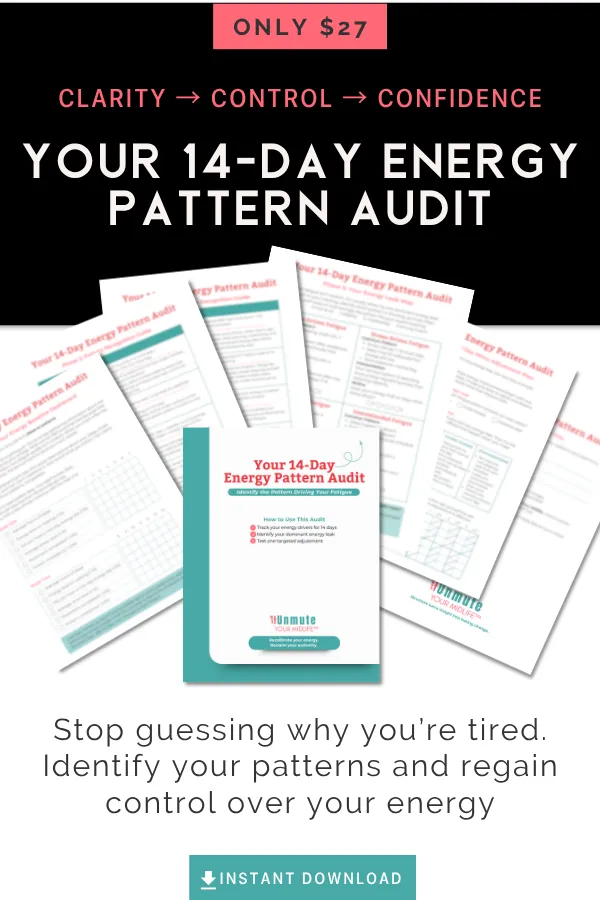
My 14-Day Energy Pattern Audit walks you through two weeks of noticing your own patterns instead of letting one bad Tuesday, one symptom, or one loud opinion explain everything. Patterns are what you bring to the appointment. They're also what tell you which lever to pull first.
Start the 14-Day Energy Pattern Audit: https://unmuteyourmidlife.com/energy-audit
This article is educational and is not individualized medical advice. Hormone therapy has benefits, risks, and contraindications that should be discussed with a qualified healthcare professional who knows your medical history.