
What If You Don't Need to Find Yourself After 50?
You're having coffee with a few women your age when the conversation takes the familiar turn. One says she doesn't know who she is anymore. Another wants to sell the house, change careers, and spend six months in Italy. Someone jokes that they're all hormonal teenagers with mortgages. You laugh, and underneath the laugh you're thinking: am I supposed to feel this way?
Because you don't feel lost. Hot at 2 a.m., yes. Standing in the pantry with no memory of why you walked in, sure. Your patience isn't what it was at 35, and your body has introduced a few new terms and conditions without consulting you. But you still know who you are.
If that's you, here's a possibility that gets almost no airtime in conversations about women and midlife. Maybe you don't need to find yourself after 50. Maybe the better question is whether the woman you already know yourself to be still fits the life you're living.

Identity loss is normal, but not a required symptom
Some women do experience a shift in identity during the menopause transition, and the research on how women describe these years confirms how widespread it is. Changing bodies, changing roles, and cultural expectations send some women back to first principles about who they are. Others describe this same stretch of time as the first real chance to put their own goals in front of everyone else's.
So if menopause has rattled your sense of self, take that seriously. But also realize, it's not like there is some memo that arrives with your first irregular period instructing you to question your marriage, buy linen pants, and go find yourself in Tuscany. As Austin Powers would say, "that's not your bag, baby." Maybe you know exactly who you are. Your source of friction may be somewhere else entirely.
What you've outgrown, and kept anyway
The question I've gotten far more interested in: what are you tolerating now that no longer fits the woman you've become?
Maybe you're still the dependable one, and you're tired of being the automatic answer every time somebody needs something. Maybe you've spent years being agreeable because keeping the peace was easier than explaining what you wanted. Maybe you love your work and no longer want it taking the best hours of every day. Or maybe nothing is wrong, your life looks good from the outside, and you just keep hearing a small internal no while your mouth says "that's fine."
A woman can know herself extremely well and still be living according to decisions she made at 32.
Why the old patterns get louder now
Menopause doesn't happen in a vacuum. For most women the physical transition shows up in years already crowded with work, aging parents, changing relationships, kids who are nearly out of the house, money, and their own health.
A 2025 qualitative study of 509 Australian women found exactly that pile-up. Some women described serious physical and emotional effects; others described relief. What they had in common was that the menopause years collided with caregiving, careers, finances, and relationships. Collided really is the right word for this!
Sleep and mood take a hit for many women too, and The Menopause Society notes that women vary widely both in which symptoms they get and in how much those symptoms bother them. This matters for one practical reason: depletion makes everything feel louder. Louder isn't truer. Before you decide the job has to go or the marriage is doomed or you've become a stranger to yourself, give yourself enough room to tell a real desire for change apart from a body begging for recovery. As I've advised in other posts, don't make permanent decisions from a temporary state of depletion.
Knowing who you are and living like her
These are two different skills, and the second one (living out your true identity) is harder.
You can know that you value your health and still put yourself last for a decade. You can know you need space but keep filling every open square on the calendar. You can know exactly what you want to say and then listen to yourself soften it until nobody could possibly be uncomfortable. None of that is an information problem. You already heard yourself. The only question left is whether you'll act on it.
And that's where midlife gets uncomfortable, because self-leadership sounds lovely right up until somebody is disappointed by one of your decisions. Until you stop explaining your reasoning to everyone. Until an old role loses automatic access to you. Until "I've always done it this way" stops counting as a reason. Knowing yourself doesn't spare you that discomfort. It gives you something solid to stand on while you go through it.

Of course women change after 50
We should. Experience changes us. So do loss, illness, divorce, success, caregiving, and everyday afternoons when we've simply had enough.
Change doesn't mean you lost yourself. Sometimes it means the version of you who could tolerate a situation for 15 years just can't tolerate it anymore. Sometimes it means you finally have enough evidence to admit a choice isn't working. And sometimes it means you've realized that a trait you thought was your personality was really a behavior that helped you belong, avoid conflict, or keep everyone else comfortable.
That's not a small distinction. "I need to find myself" sends you out looking for a missing woman. "What am I no longer willing to tolerate?" puts the decision back in your hands.
You probably don't need a reinvention
There's an entire industry ready to sell you a new identity at midlife. New body, new morning routine, new wardrobe, new purpose, new supplement stack, new life. Most women I talk to don't need another project.
You may need actual treatment for symptoms that are wrecking your days. You may need sleep. You may need to finally have the conversation you've rehearsed 47 times in the shower. And you may need someone who can reflect a pattern back to you when you're standing too close to see it. Information can tell you what's possible. It can't choose for you.
In my own case, I needed an overhaul. I had to start with changing jobs so I could have a little more control over my calendar and make time for proper sleep and nutrition. Then I added hormones and movement. Once my body was getting its needs met, the identity work could happen. It really does go in order though. In school this is reinforced by Maslow's Hierarchy of Needs: you can't ignore sleep and think that any identity work will be effective.
Before you go looking, listen
If you don't feel lost after 50, don't manufacture a crisis because midlife culture told you one was coming. And if something does feel wrong, don't assume the answer is to become a different woman. Get quieter about the label and more specific about the friction. Where are you saying yes on autopilot? What are you maintaining only because you've always maintained it? Where do your actions keep contradicting something you already know about yourself?
The woman you're trying to find has probably been talking the whole time. The question is what you do when you hear her.
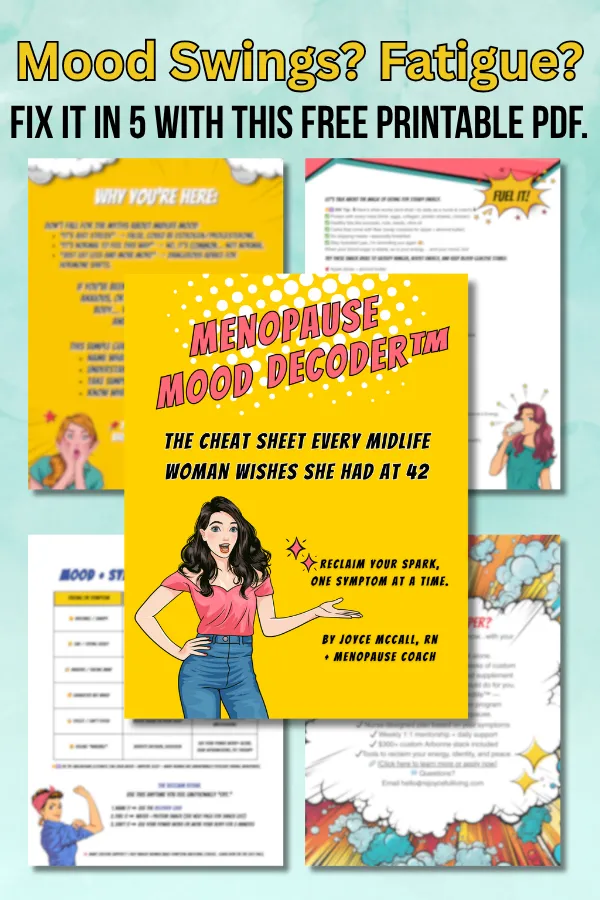
Try the Menopause Mood Detector
If you're trying to sort out whether what you're feeling is hormones, overload, an old pattern, or some messy combination of all three, start with the Menopause Mood Detector. Use it to get specific about what's happening before you turn a hard week into a verdict about your whole life.
You don't need a quiz to tell you who you are. You need enough clarity to decide what happens next.
This article is educational and isn't medical or mental health advice. Significant or persistent changes in mood, cognition, or functioning deserve a conversation with an appropriate healthcare professional.