It's Not a Midlife Crisis. It's the Big Squeeze.
What if the exhaustion you're feeling in midlife isn't a crisis of meaning at all... but a math problem nobody warned you about?
We've all been handed the same tidy little story about this season of life: the 'midlife crisis.' The image is almost cartoonish. Someone buying a flashy convertible, trading out their spouse for a younger version, having an existential meltdown about mortality, questioning every choice they've ever made. It's framed as something happening inside you. A private psychological event. Your own personal unraveling.
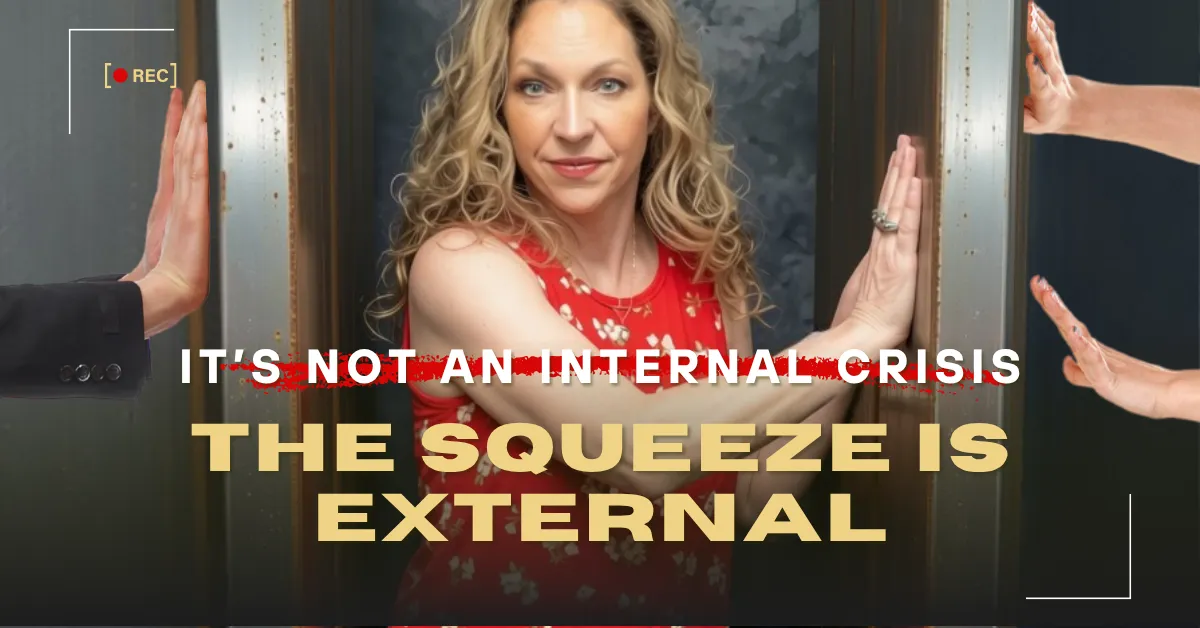
What if it was never a crisis of the soul? What if it's a SQUEEZE on your calendar, your bank account, and your body all at the same time?
I want to offer you a completely different name for what you're actually experiencing: the Big Squeeze. And by the end of this post, you'll see why this reframe changes everything. After all, you cannot fix a structural problem with a self-help solution, and you've probably been blaming yourself for something that was never your fault to begin with.
The Crisis That Was Never a Crisis
Here's the thing about the 'midlife crisis' label: it puts the problem inside you. It suggests that if you're struggling, it's because you're having some kind of internal breakdown about getting older. That you need to work on your mindset, your gratitude, your acceptance of aging.
Granted, the emotional layer of midlife is real, and we talk about it here all the time. But the midlife crisis narrative quietly does something sneaky: it takes an external, structural overload and repackages it as a personal, psychological failing.
You're not in crisis because you can't handle midlife. You're squeezed because you're financially and physically supporting three generations at once, probably with less help than any generation before you.
That's not angst. That's not you being dramatic or ungrateful or bad at coping. That's a genuine, measurable, external pressure and the data on it is honestly staggering.

The Math of the Big Squeeze
Let me show you what's actually pressing on you, because once you see the numbers, the guilt starts to loosen its grip.
Roughly a quarter of all adults are part of the 'sandwich generation.' They are simultaneously raising or financially supporting a child while also caring for an aging parent. Among women in their 40s, that number climbs even higher. This isn't a rare, unlucky situation. It's the default setting for midlife right now.
76% of sandwich-generation adults say caring for everyone is almost like having a second full-time job. Ummm, because it is one.
And the financial squeeze is brutal. The cost of raising a child to 18 now tops $300,000, and that's before college. On the other end, in-home elder care can run $75,000 a year, and a private nursing home room over $116,000. Meanwhile, nearly 60% of this generation has reduced or stopped saving for their own retirement just to keep everyone else afloat.
One report even called it a 'money leak': the simultaneous drain of paying for childcare and elder care at the same time. And if that phrase sounds familiar to you as one of my readers, it should. Because this is the exact same pattern we talk about with energy: you're not broke or broken. You're leaking money, time, and capacity through a system that's quietly siphoning all three at once.
Why the Reframe Actually Matters
You might be thinking, okay — but naming it doesn't make the squeeze go away. And you're right. So why does this reframe matter so much?
Because you cannot solve the right problem while you're blaming yourself for the wrong one.
When you think it's a personal crisis, you look for personal fixes. When you see it's a structural squeeze, you start making structural moves.
As long as you believe your exhaustion is an internal failing, you'll keep reaching for internal solutions. Things like more discipline, more gratitude, more trying to 'fix your attitude.' You'll keep quietly wondering what's wrong with you. And you'll keep absorbing the entire weight of a multi-generational, systemic pressure as though it were a personal character flaw.
But the moment you name it the Big Squeeze, everything shifts. You stop asking 'what's wrong with me?' and start asking 'how do I redistribute this load?' You stop white-knuckling through and start having real conversations about money, time, and shared responsibility. You stop self-abandoning in the name of holding everyone else up.
This is the same principle at the heart of everything I teach: it's not what you're doing, it's what you're tolerating. And you've been tolerating carrying a structural weight alone and calling it a personal shortcoming.
What Holding the Squeeze Differently Looks Like
So what do you actually do with this? Not a tidy five-step fix because the squeeze is real and I won't insult you by pretending a checklist dissolves it. But the reframe does open up moves you couldn't see before.
You start naming the load out loud, to the people in it with you. Experts on this consistently say the single most protective thing is open conversation with family about the time, money, and support because the burden crushes hardest when it sits silently on one person. Usually her. Usually you.
The squeeze becomes unbearable when it's invisible and solo. Named and shared, it becomes something a family carries — not something quietly breaking one woman.
You look for the outside support that actually exists. Check out respite care, adult day services, tax credits for dependents and caregiving, employer caregiver benefits. Don't assume you have to personally be the whole safety net. You protect your own resources, including your retirement, as a non-negotiable rather than letting it be the first thing you sacrifice.
And you release the self-blame. Not because the pressure isn't real, but because guilt is just one more thing draining your capacity — and you need every bit of capacity you have for the actual squeeze, not for the imaginary crisis you were told was your fault.

Your Reality-Based Reframe
You were handed a story that said midlife struggle is an internal crisis, a private failure of mindset, a personal unraveling you're supposed to fix from the inside.
That story is wrong, and it's costing you. What you're actually feeling is the Big Squeeze: a real, external, structural overload of holding up three generations at once, with a thinner safety net than anyone before you, while quietly being told to be grateful and get your attitude right.
It's not a crisis of meaning. It's a squeeze on your time, your money, and your body. And you are not failing it. You're surviving it.
Naming it doesn't erase the pressure. But it moves the problem out of your head, where you can't solve it, and into the real world, where you can actually start making moves. Moves like redistributing the load, claiming outside support, protecting your own resources, and dropping the guilt that was never yours to carry.
You're not in crisis. You're in a squeeze. And a squeeze is something you can share, strategize, and stop absorbing alone.