You know what needs to change. So why aren’t you changing it?
At 9:47 p.m., you’re on the couch with your phone in your hand, mentally reviewing three other people’s schedules.
Your mom’s follow-up appointment. Your adult child’s next problem. The deadline at work that’s about to turn into a fire drill. You know what everybody needs, when they need it and probably what will happen if they don’t get it.
But when you ask yourself, “What needs to change in my own life?” you already know the answer.
You need more rest. You need to make the appointment. You need to stop saying yes to the thing you resent every single week. You need to protect time for the part of your life you keep calling “someday.”
So why don’t you?
Because knowing what to do and leading yourself to do it are two different jobs. This article explains the difference between knowing, choosing and self-leading, so you can stop treating your own life like the project you’ll get to after everyone else is handled.

Why do I know what to do but still don’t do it?
You may not have an information problem.
You may have a self-leadership problem.
That’s not an insult. It’s a pattern.
Most capable women have spent years becoming excellent at responding. You notice a need, anticipate a problem, remember the detail, make the call, pick up the slack. People trust you because you handle things.
Then your own needs show up.
And somehow they become negotiable.
You know you need to sleep more consistently. You know your exhaustion deserves attention. You know you want to move your body, take the class, change the work arrangement, get more support or finally ask the question you keep avoiding.
But knowing stays theoretical when every competing request gets treated as more urgent than the promise you made to yourself.
That’s the gap.
Knowing, choosing and self-leading are different
Knowing is awareness.
You know something isn’t working. You can name it. You may have read books, listened to podcasts, saved posts and discussed it with a friend over lunch.
Choosing is the moment you decide what gets your time, money, energy or attention next.
Self-leading is what happens after the choice gets inconvenient.
That’s where most women get stuck.
Let’s say you decide Sunday afternoon is for recovery. You plan to read, nap, take a walk or sit somewhere without being asked to solve a problem. Then someone calls and asks for a favor. It isn’t an emergency. They could ask someone else. But you feel the familiar pull to rearrange yourself.
Knowing says, “I need rest.”
Choosing says, “Sunday afternoon is mine.”
Self-leading says, “I’m not available then.”
That last part can feel uncomfortable, especially if being helpful has become part of how you see yourself. But discomfort isn’t proof you made the wrong choice. Sometimes it’s proof you’re interrupting a very old arrangement.
Why capable women have such a hard time changing their own lives
Capable women disappear in respectable ways.
You don’t run away from your life. You show up. You do your job. You care for people. You manage the house, remember the prescriptions, bring the snack, organize the birthday dinner and answer the text nobody else answered.
And people appreciate you for it.
The problem is that being needed can become so familiar that you stop checking whether every responsibility still belongs to you.
Some things absolutely do need your care. A family emergency is different from your coworker wanting you to cover a shift so she can go to bingo. Your aging parent needing immediate help is different from automatically becoming the person who manages every adult relative’s appointment calendar.
The question is not, “Should I care about people?”
Of course you should.
The question is: What am I still managing out of habit, guilt or fear of disappointing someone?
Because every time you automatically give away the time you set aside for yourself, you teach yourself that your plans are optional.
That message adds up.

“I’ll deal with it after this season” can become years
Many women postpone their own decisions because life feels temporarily demanding.
After the kids settle down.
After work slows down.
After Mom is doing better.
After the house project is finished.
After everybody else stops needing something.
But life doesn’t usually clear its throat, step aside and announce that you may now begin living. There will always be another request, another transition, another open browser tab in your brain.
Waiting for a season with no competing demands is a bad plan. That season may never come.
Midlife can be a chance to reconsider the arrangement. Not to blow up your life, quit your job or get panic bangs. Just to ask whether the rules you made 10 or 20 years ago still fit the woman you are now.
You’re allowed to change an agreement you made with yourself when your life required something different.
Four questions to ask when you feel stuck
Start here. Write your answers down, even if they feel messy.
What am I still managing that no longer needs me?
Look for responsibilities that could be shared, delegated or returned to the person whose life they belong to.
What am I tolerating because I’ve called it “just a season”?
Be honest. A season has an end date. If it has lasted five years, it may be an arrangement.
If my energy belonged to me, where would I spend it?
Don’t make this practical yet. Let your answer be a little unreasonable. Maybe you want to learn drums at 53. Maybe you want to take a nap on Sunday without explaining yourself. Put it on paper.
What would I decide if I didn’t have to explain it to anyone?
This question usually brings up the thing you’ve been editing out of your own life before it even gets a chance.
The change starts with one protected decision
You do not need a five-year reinvention plan.
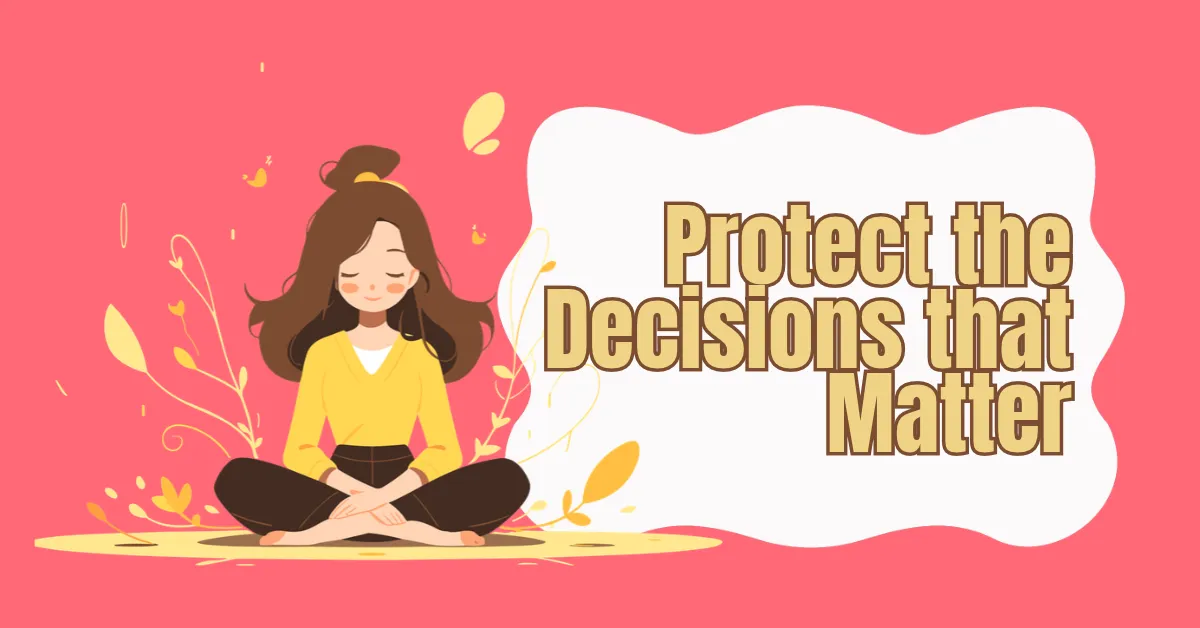
You need one decision you can protect this week.
Write this sentence at the top of a page:
If my time actually belonged to me, I would…
Make a list of 10 answers. Circle one thing you can do in the next seven days. Put it on your calendar.
Then pay attention.
What happens when that time arrives and someone asks for access to it?
Do you defend your plan before anyone challenges it? Do you feel guilty? Do you reschedule yourself without even considering another answer?
There’s your information.
You already know more than you think you do. The work is learning to stop renegotiating with yourself every time somebody else wants something.
Your life does not need to wait until everyone around you is finished needing you.
It needs a place in the plan now.
Ready to see where you keep giving your own decisions away?
The Unmute Self-Leadership Audit helps you identify the pattern draining your capacity, where you keep renegotiating with yourself and one decision to protect for the next seven days.
You don’t need another generic list of things you “should” do. You need a clear mirror and a starting point you can actually use.